How to Practice for the TEF and TCF Speaking and Writing Sections
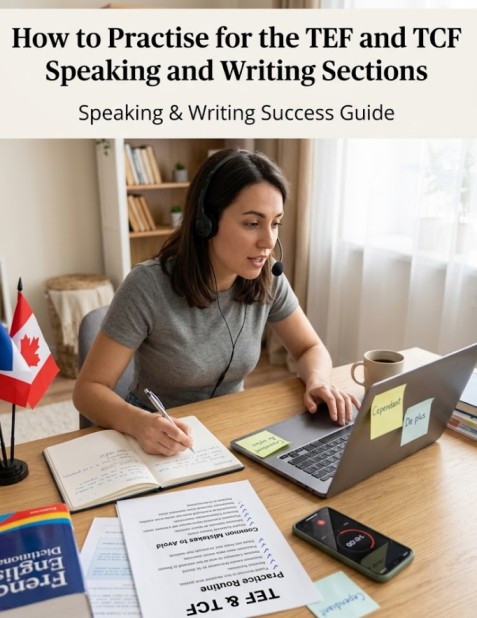
Writing and speaking are where most TEF and TCF candidates lose points. Here are practical, step-by-step methods to prepare for both: how the tasks are structured, useful French phrases, a weekly practice routine and the common mistakes to avoid.
Quick answer: To score NCLC 7 in speaking and writing, practise the exact task formats under time pressure, use a clear structure with linking words, record yourself, and get feedback from a teacher. Doing this weekly matters more than studying long hours once in a while.
Why speaking and writing decide results
Listening and reading are multiple-choice, so you can improve with volume and technique. Writing and speaking are produced by you and marked on grammar, vocabulary, coherence and task completion. They are also the two skills most learners practice least, and for the French bonus you need NCLC 7 in every skill (see How Many CRS Points Does French Give in Express Entry?).
Know the format
As a general guide (always confirm in the latest official candidate guide, since formats can be updated):
- TEF Canada speaking: two sections. In the first you ask questions to get information from an advertisement; in the second you try to convince a friend about something.
- TEF Canada writing: two sections. In the first you continue a short news item; in the second you write a letter or text giving and defending your opinion, with a minimum word count for each.
- TCF Canada speaking: three tasks: a short guided interview, a role-play style interaction, and expressing your point of view.
- TCF Canada writing: three tasks of increasing length, ending with a task where you summarize and compare two documents.
Not sure which exam to take? Read TEF Canada vs TCF Canada.
How to practice speaking
- Record yourself. Answer a practice prompt for 2 minutes on your phone, then listen back. You will notice pauses, repeated words and wrong tenses immediately.
- Use a simple structure. Opinion, two reasons, one example, conclusion. A clear structure keeps you talking.
- Never stay silent. If you forget a word, describe it in simpler French. Fluency and communication matter more than perfect vocabulary.
- Shadow native speakers. Repeat short audio clips right after they speak, copying rhythm and intonation.
- Practice with a partner or teacher. Live conversation is different from solo practice. Ask for corrections on your most frequent mistakes.
Useful phrases
- Giving an opinion: À mon avis…, Je pense que…, Selon moi…
- Listing ideas: D'abord…, Ensuite…, D'une part… d'autre part…
- Contrast: Cependant…, En revanche…, Pourtant…
- Asking for information politely: Pourriez-vous me préciser… ?, Je voudrais savoir si…
- Concluding: En conclusion…, Pour toutes ces raisons…
How to practice writing
- Plan for 3 minutes. Jot down your introduction, two or three arguments and your conclusion before you write.
- Use paragraphs and linking words. Examiners reward organized texts. Connectors such as en outre, par conséquent and c'est pourquoi show control.
- Respect the word count. Too short loses points; far too long wastes time and adds errors.
- Leave 3 minutes to proofread. Check verb agreement, accents, gender and spelling of common words.
- Study model answers. Read good answers, note their structure and phrases, then write your own on the same topic.
- Get your writing corrected. Without feedback you repeat the same mistakes.
A simple weekly routine
- 2 short recorded speaking answers (5 minutes each)
- 1 timed writing task, then self-correction
- 1 listening session at natural speed
- 1 live speaking session or teacher feedback, if possible
- Every 2 to 3 weeks: a full timed mock exam
Common mistakes
- Memorizing a script that does not answer the actual question.
- Translating word for word from English.
- Practicing only the easy skills and avoiding writing.
- Taking the exam without a single full timed simulation.
Get exam-ready with BBarters
Our Exam Practice Programs include complete exam simulations, video lessons on exam structure and best practices, model writing answers, prep templates and a one-to-one feedback session. If you are still building your base, start with the TEF TCF Online French Program, and see How Long Does It Take to Reach B2 (CLB 7) in French From Zero? to plan your timeline.
Start your French journey with BBarters
Not sure where you stand? Take our French Level Assessment, which includes a live speaking test. Ready to begin? Try the free 3-day trial of the TEF TCF Online French Program, or see all French programs. If you would like personal guidance, book a 30-minute consultation with our Principal Instructor.