Mastering the French Proficiency Test
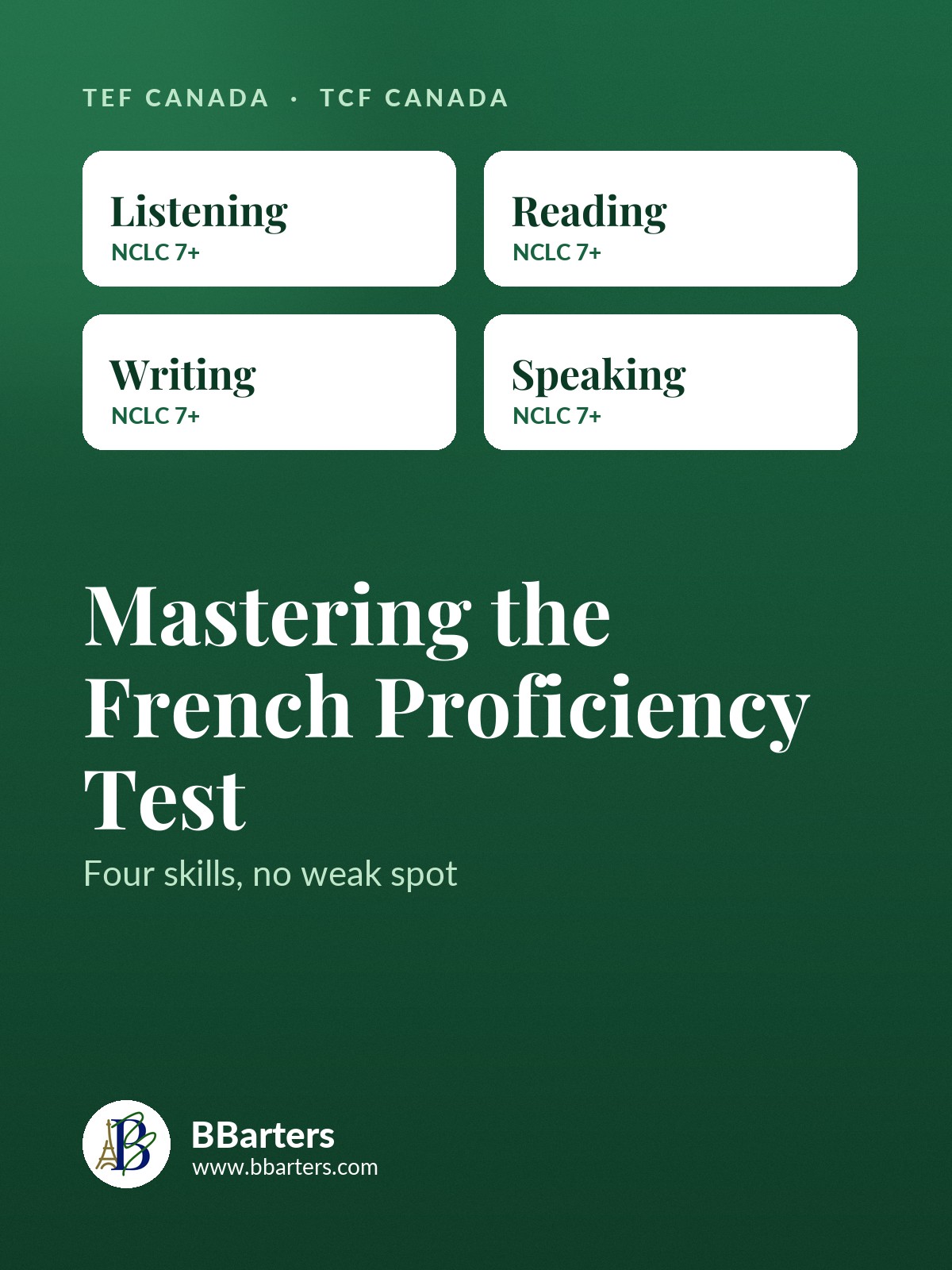
TEF Canada and TCF Canada test the same four skills, and your NCLC level in each one decides your CRS points. Here is how the tests work, how to prepare each skill, the mistakes that cost candidates a level, and a study plan for the final weeks.
Quick answer: For Canadian immigration, your French is measured with TEF Canada or TCF Canada. Both test listening, reading, writing and speaking, and each result is converted into an NCLC level. To earn the French bonus in Express Entry you need NCLC 7 or higher in all four skills, so the goal is not a high average but no weak skill.
TEF Canada or TCF Canada?
Both tests are accepted by IRCC for Express Entry, and both give you four scores that convert to NCLC levels. They differ in question styles, timing and how the writing and speaking tasks are organised. Choose the one whose format suits you and whose test dates are available near you in time. Our comparison TEF Canada vs TCF Canada: Which Exam Should You Take? and the TEF & TCF exam details page explain the formats and scoring.
How to prepare each skill
Listening
- Listen to French every day: news, podcasts and short videos at natural speed, not only learner material.
- Practise picking out the key information (who, when, why, opinion) rather than understanding every word.
- Train with timed question sets: you only hear each recording once or twice.
Reading
- Read real texts: articles, emails, announcements, opinion pieces.
- Learn to spot the main idea and the writer's intention quickly; manage your time so you reach the last questions.
- Build vocabulary by theme (work, housing, health, environment, technology): exam texts draw on everyday adult topics.
Writing
- Learn the expected structure for each task type (message, article, argument) and practise it until it is automatic.
- Use connectors (d'abord, cependant, en revanche, par conséquent) to organise your ideas: examiners reward a clear structure.
- Respect the word count and keep a few minutes to correct agreements, verb tenses and accents.
- Get feedback on your texts: you will repeat the same mistakes until someone points them out.
Speaking
- Speak French aloud every day, even alone: describe your day, give your opinion on a news item, record yourself.
- Prepare for the task types: asking questions to get information, and convincing someone with arguments and examples.
- Aim for fluency and clarity first; small grammar slips cost less than long silences.
- Practise with a real person under exam conditions before test day.
Mistakes that cost candidates a level
- Neglecting one skill. NCLC 9 in reading does not compensate for NCLC 6 in speaking.
- Never practising under timed conditions. Many candidates know enough French but run out of time.
- Memorising whole answers. Examiners notice, and memorised text rarely fits the actual question.
- Booking the test too early. Take a full mock exam first; book when your mock scores reach the level you need with some margin.
A plan for the final weeks
- Take a full practice test to find your weakest skill.
- Spend most of your time on that skill, while keeping daily contact with the other three.
- Do one complete exam simulation a week, in real time, and review every mistake.
- In the last week, rest, review your writing and speaking structures, and check the test-day rules.
Practice with real exam simulations
Our TEF Canada and TCF Canada Exam Practice Programs give you complete exam simulations, lessons on the exam structure, model answers and a one-to-one feedback session. If you are still building your level, start with the TEF TCF Online French Program.